Članak prati transformaciju američke svemirske agende — od državne, hladnoratovske misije Apolla do savremenog, delimično komercijalizovanog programa Artemis. Dok NASA planira povratak na Mesec i perspektivu leta ka Marsu, suočava se sa opadajućim javnim interesom, ograničenim budžetom i novim geopolitičkim rivalstvima, posebno Kinom. Uspeh će zavisiti od finansijske podrške, međunarodne saradnje i jasne vizije.
Dok Amerika Slavi 250 Godina: Zašto Mesec Ponovo Testira Američku Ambiciju?
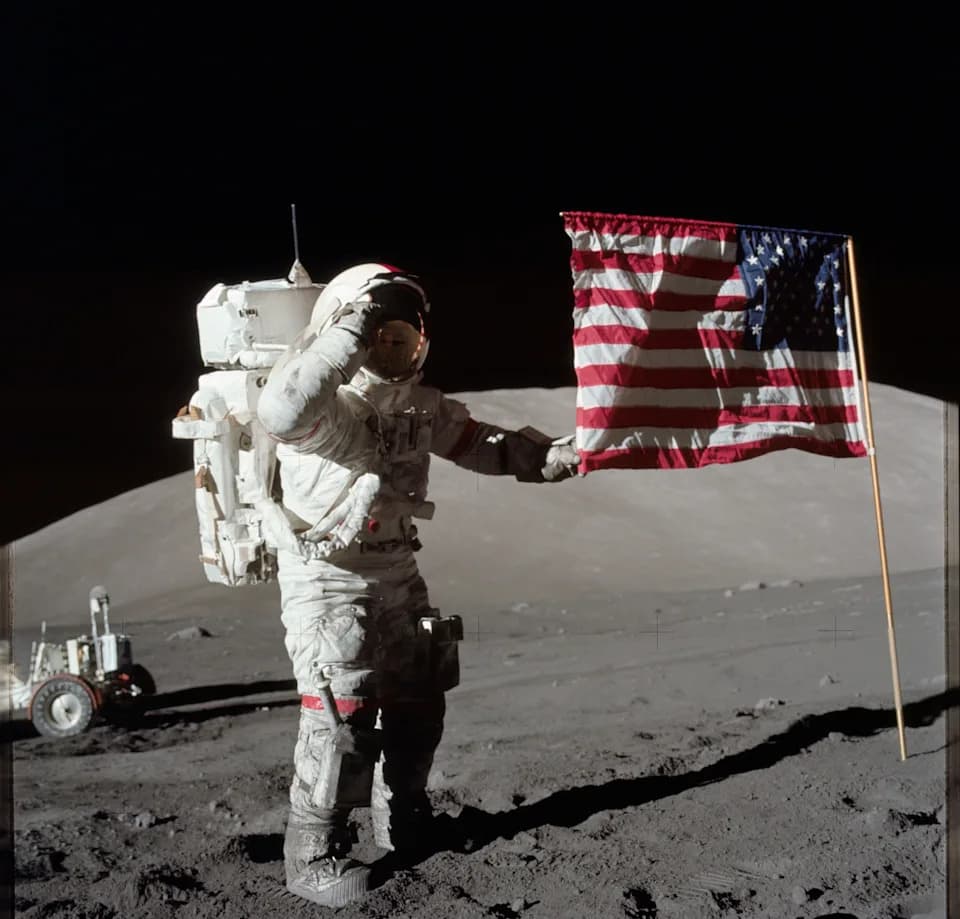
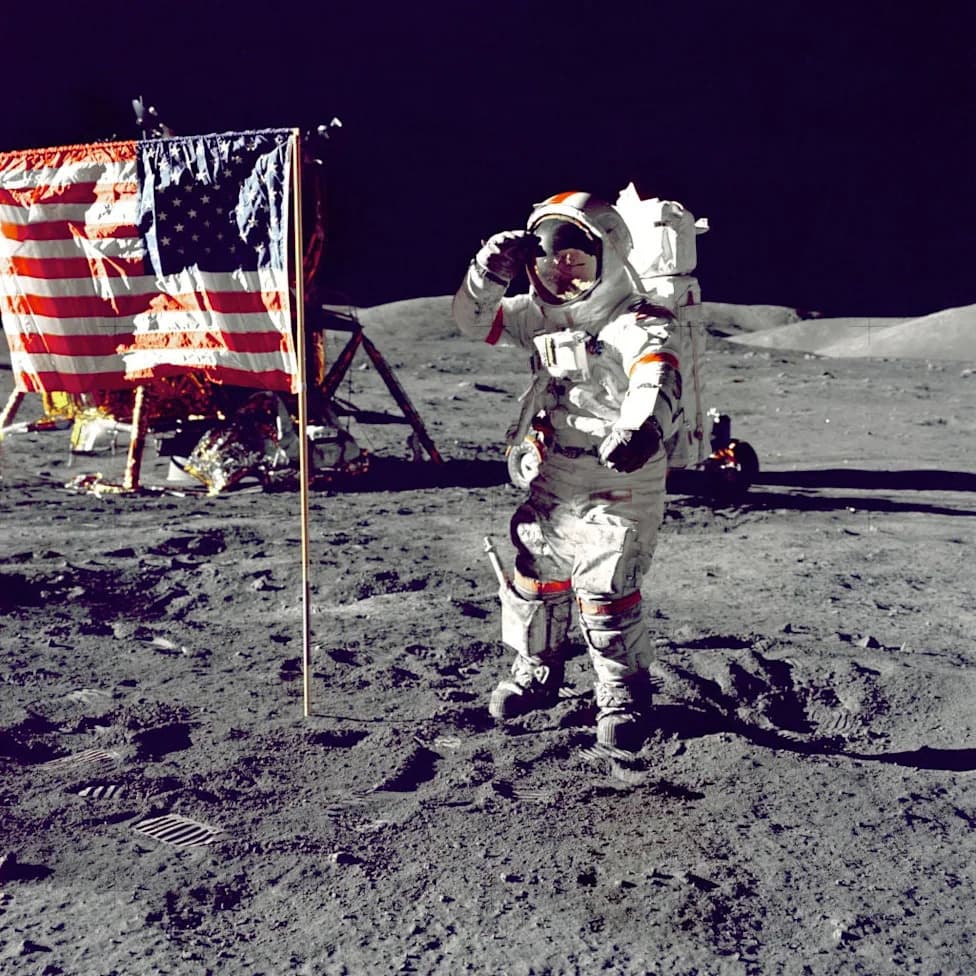
Astronaut Eugene A. Cernan, Apollo 17 commander, is photographed next to the deployed United States flag during lunar surface extravehicular activity (EVA) at the Taurus-Littrow landing site. The highest part of the flag appears to point toward our planet Earth in the distant background. This picture was taken by scientist-astronaut Harrison H. Schmitt, lunar module pilot.
Kapetan Eugene Cernan poslednji put je ostavio ljudske otiske na Mesecu 1972. godine: poskakao je po površini, popeo se merdevinama Apolla 17 i, pre nego što se ukrcao, rekao je da veruje kako će „istorija zabeležiti kako je današnji izazov Amerike oblikovao sudbinu čovečanstva sutra“ — i da će, ako Bog da, ljudi opet kročiti na Mesec sa mirom i nadom za čitavo čovečanstvo.
Od Apolla do Artemisa: Kako su se ciljevi promenili
U eri Hladnog rata, svemirska trka je bila simbol nacionalne volje. John F. Kennedy je 1961. postavio cilj — sleteti čoveka na Mesec pre kraja decenije — i to je podstaklo ogroman savez javnih resursa, obrazovanja i industrije. Samo u sredini 1960-ih NASA je trošila približno 4,4% američkog BDP-a; danas su izdaci blizu 0,4%.
Apollo program je doneo tehnološke i kulturne promene: inspirisao je generacije naučnika i inženjera i iznedrio tehnologije koje su uticale na svakodnevni život. Ipak, nakon kraja Apolla javni interes i politička podrška su opali — tragedije poput eksplozije Challengera 1986. i česte promene predsedničkih prioriteta dodatno su smanjile zamah.
Svemir danas: privatizacija, strategija i konkurencija
Danas je model istraživanja svemira delom komercijalizovan: kompanije kao što su SpaceX i Blue Origin preuzimaju ključne logističke uloge, a NASA postavlja ciljeve i ugovara kompletna rešenja. To donosi inovacije, ali i pitanje profita — misije sa ljudskom posadom sve više se planiraju uz korporativne interese.
Politika i geopolitika ostaju važni: SAD sada promovišu program Artemis kao put povratka ljudi na Mesec i osnovu za buduće misije na Mars, dok Kina ubrzano razvija sopstvene programe sa ambicijom sletanja do 2030. godine u oblasti južnog pola Meseca, gde se veruju naslage leda.
Artemis: planovi, problemi i javni interes
Artemis I (neposredni orbitalni let bez posade) je uspešno lansiran 2022. Artemis II je planirani let sa posadom koji bi napravio gravitacioni zamah oko Meseca, ali suočava se sa kašnjenjima i tehničkim problemima; unutrašnje promene u planu Artemis programa znače da se redosled misija i rokovi menjaju. Budžet NASA u 2025. iznosi otprilike 25 milijardi dolara godišnje — daleko manje u odnosu na procenjeni realni izdatak tokom 1960-ih.
Istovremeno, istraživanja pokazuju podeljeno javno mnjenje: velika većina Amerikanaca želi da SAD ostanu lider u svemiru, ali tek manjina vidi povratak na Mesec ili put na Mars kao najviši prioritet za NASA-u.
„Previše godina je prošlo da bih ja bio poslednji čovek koji je ostavio otiske na Mesecu“, napisao je Cernan. „Verujem da negde postoji mladić ili devojka koji će to promeniti.“
Zašto je to važno i šta sledi
Svemirski program više nije samo pitanje prestiža: on uključuje pitanja ekonomije, bezbednosti, međunarodne saradnje i komercijalizacije. Povratak na Mesec i plan za Mars zahtevaće stabilno finansiranje, jasnu viziju i strpljenje javnosti — a to su resursi koji danas nisu lako dostupni.
Autorstvo: Tekst je adaptacija izvorne reportaže Sarah D. Wire za USA TODAY.

President John Fitzgerald Kennedy delivers a speech before the joint Congress on May 25, 1961, in Washington D.C. where he argues for support for the nation's space program and says "I believe that this nation should commit itself to achieving the goal, before this decade is out, of landing a man on the moon and returning him safely to the earth."
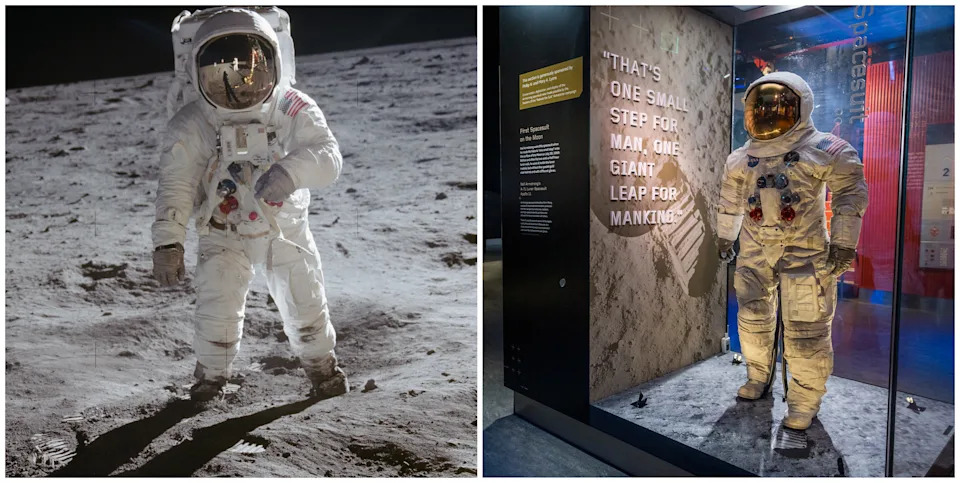
Left: Apollo 11 astronaut Edwin “Buzz” Aldrin Jr. walks on the surface of the moon on July 20, 1969. Astronaut Neil Armstrong was the first person to step on the moon followed by Aldrin. Right: Neil Armstrong’s Apollo 11 spacesuit is on display at the Smithsonian Air & Space museum in Washington, DC.
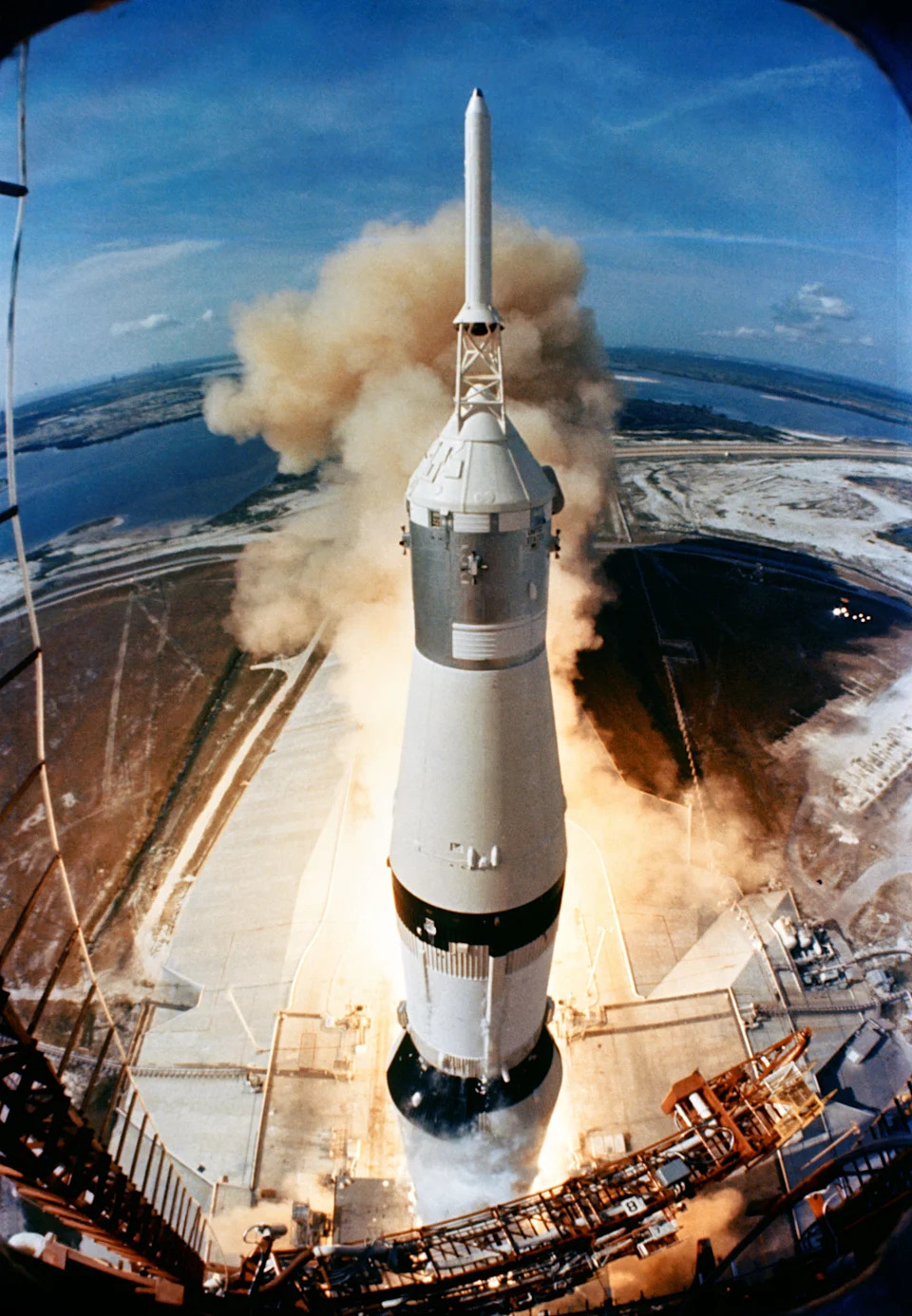
The huge, 363-feet tall Apollo 11 space vehicle launches from Pad A, Launch Complex 39, Kennedy Space Center, at 9:32 a.m. on July 16, 1969. Onboard the Apollo 11 spacecraft were astronauts Neil A. Armstrong, commander; Michael Collins, command module pilot; and Edwin E. Aldrin Jr., lunar module pilot. Apollo 11 was the United States' first lunar landing mission. While astronauts Armstrong and Aldrin descended in the Lunar Module (LM) "Eagle" to explore the Sea of Tranquility region of the moon, astronaut Collins remained with the Command and Service Modules (CSM) "Columbia" in lunar orbit.
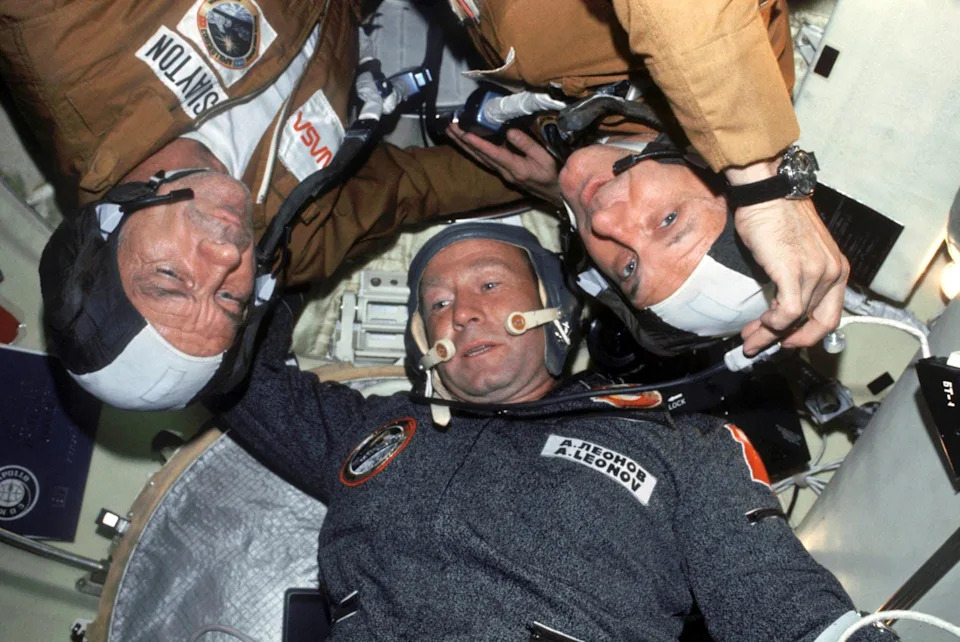
Astronaut Donald K. Slayton, cosmonaut Aleksey A. Leonov and astronaut Thomas P. Stafford are photographed in the Soviet Soyuz during the Apollo-Soyuz Test Project docking mission in Earth orbit, July 17, 1975.
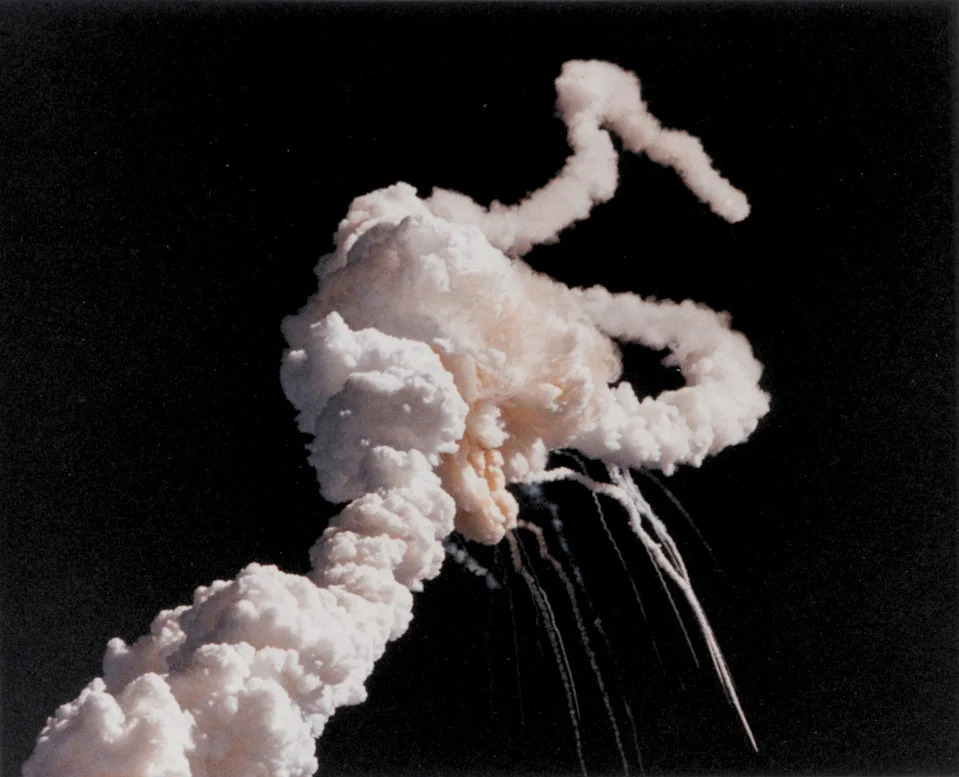
The space shuttle Challenger and her seven-member crew were lost when a ruptured O-ring in the right solid rocket booster caused an explosion soon after launch from the Kennedy Space Center in this NASA handout photo dated Jan. 28, 1986. This photograph, taken a few seconds after the accident, shows the space shuttle main engines and solid rocket booster exhaust plumes entwined around a ball of gas from the external tank.
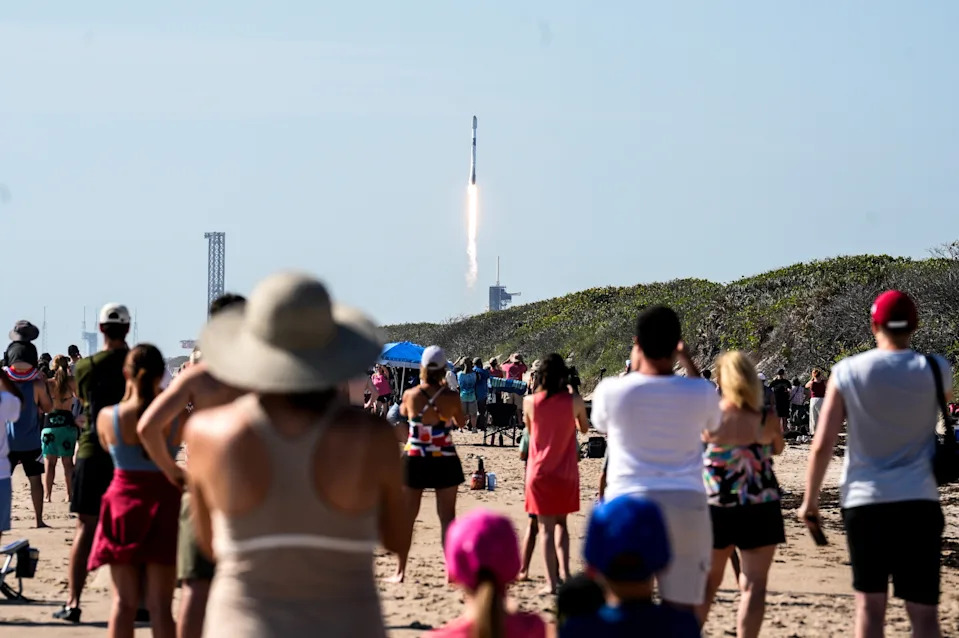
Spectators watch from Playalinda Beach on the Canaveral National Seashore as a SpaceX Falcon 9 rocket lifts off from Pad 39A at Kennedy Space Center, Fla. on May 28, 2025 carrying 27 Starlink internet satellites.
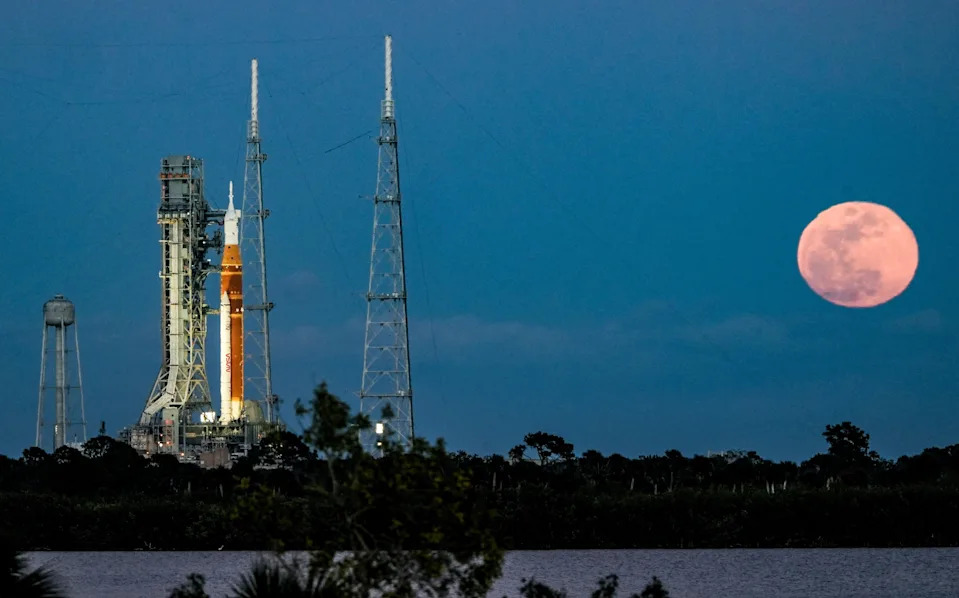
The full moon rises as Artemis II sits on Pad 39B at Kennedy Space Center Feb. 1, 2026.
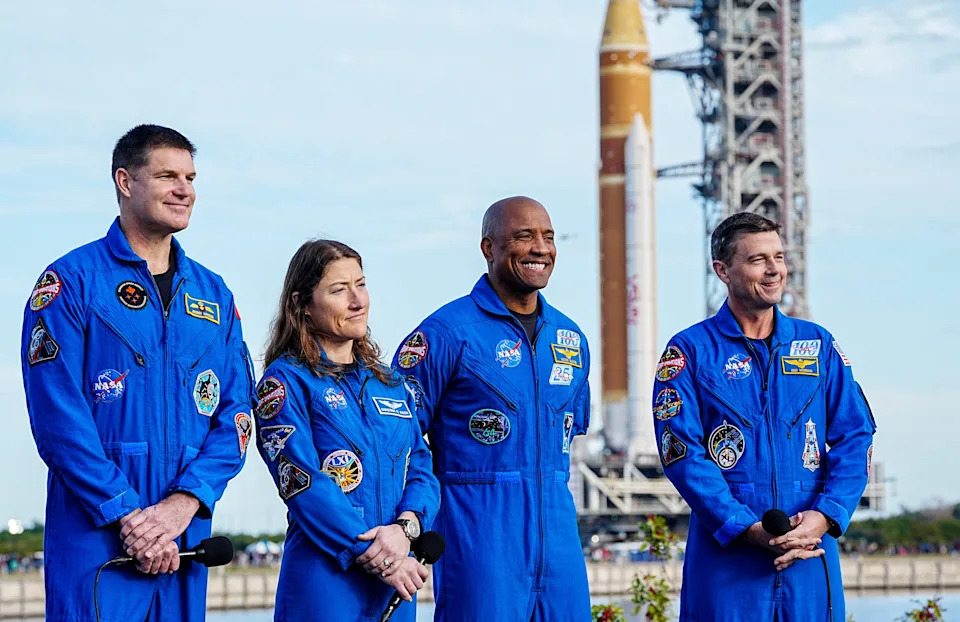
The crew of Artemis II (from left) Jeremy Hansen, Christina Koch, Victor Glover and Reid Wiseman pose for pictures as their ride to the moon is transported from the Vehicle Assembly Building at Kennedy Space Center, Fla. to the launch pad Jan. 17, 2026.
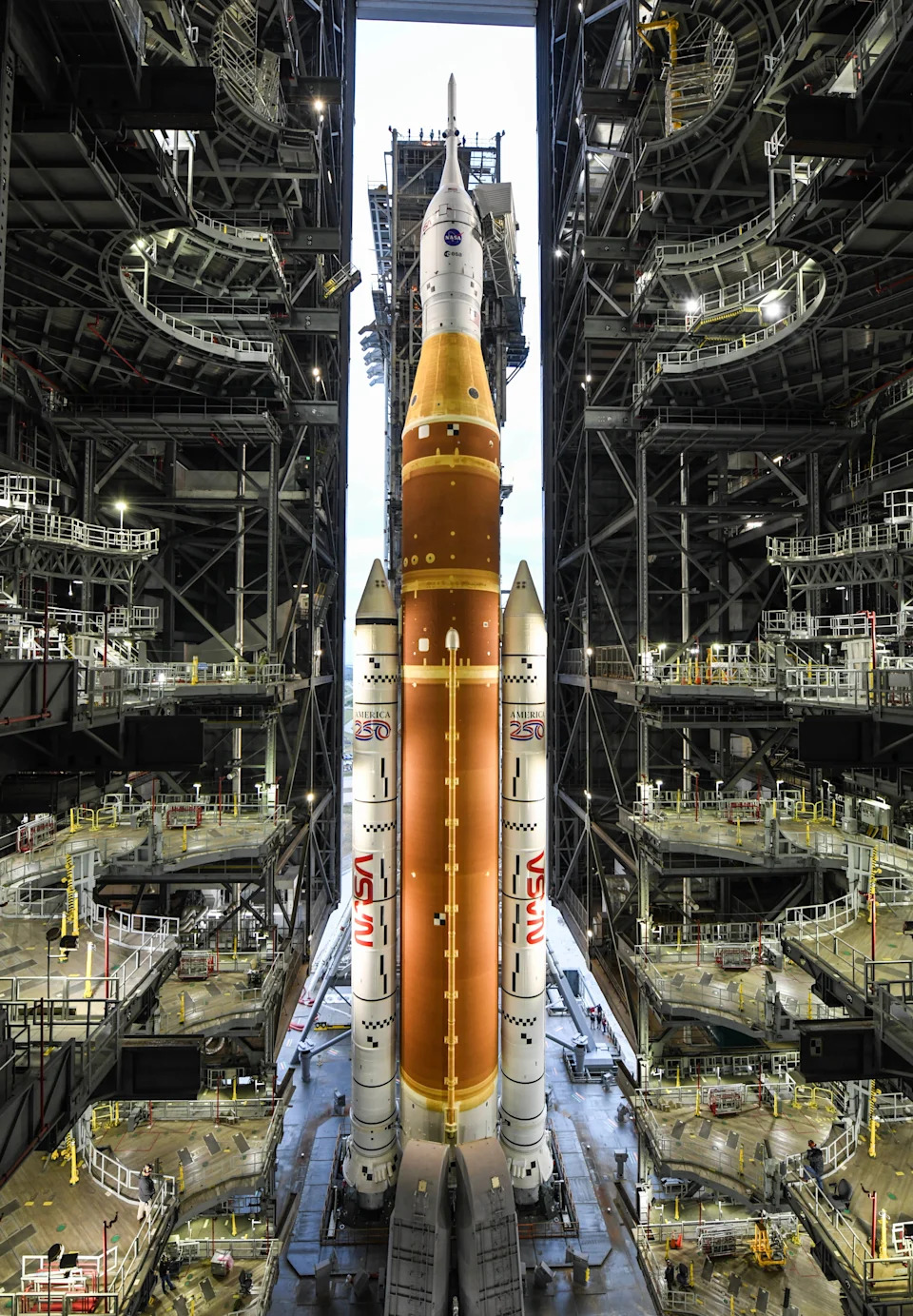
Artemis II begins its journey from the Vehicle Assembly Building at Kennedy Space Center, Fla. to the launch pad Jan. 17, 2026.
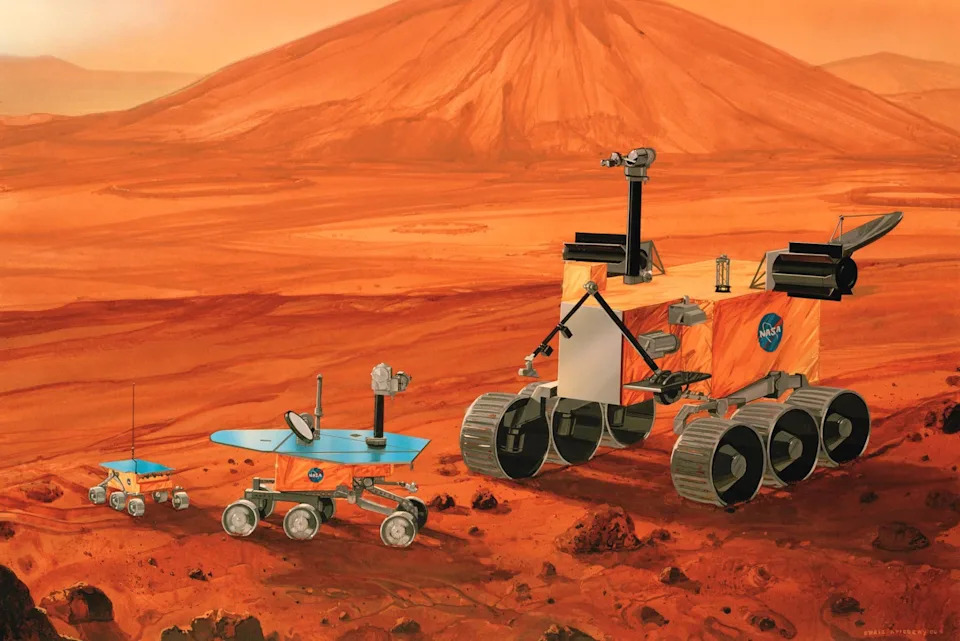
NASA has sent five robotic vehicles to Mars. Sojourner, Spirit, Opportunity, Curiosity, and Perseverance. Look back at the missions.
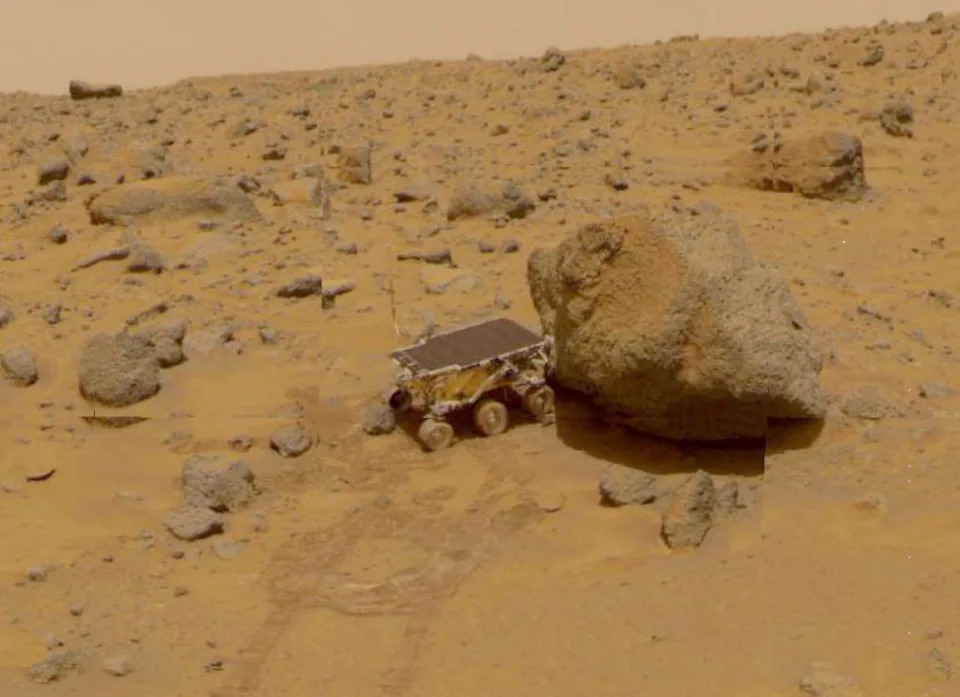
View of the NASA Pathfinder Sojourner Rover robotic data gathering vehicle exploring the surface terrain of the planet Mars, 1997.
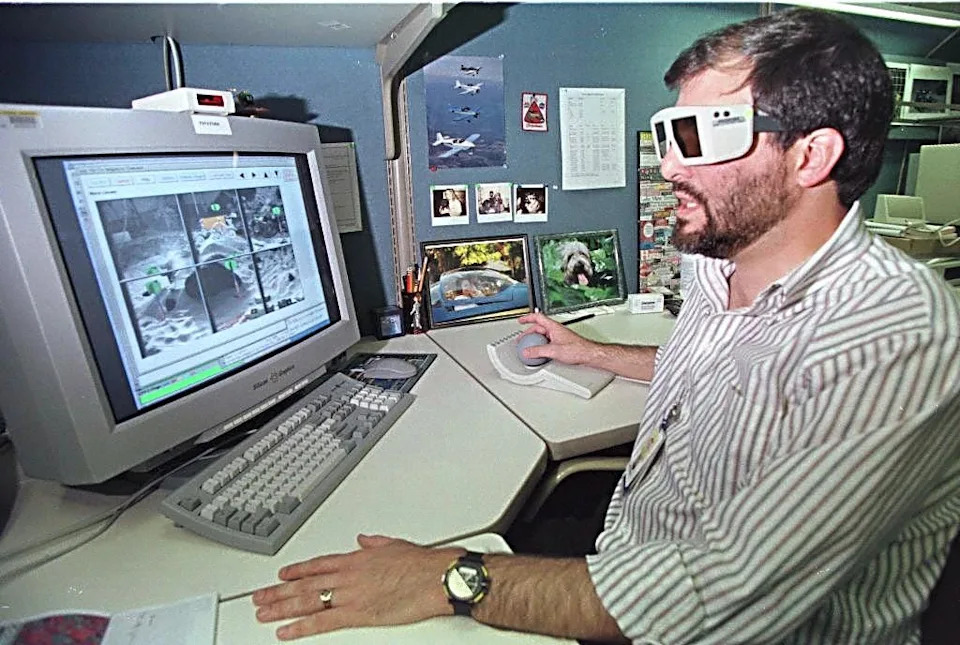
Brian Cooper, who will command the Mars Pathfinder rover "Sojourner", uses 3-D glasses on July 1,1997 to operate the mechanical explorer which will give him a three dimensional view of the Martian surface. He will receive pictures of the Martian surface including Sojourner from the camera on the Mars Pathfinder Lander.
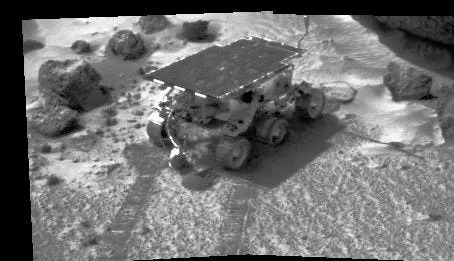
This July 8, 1997 NASA photo taken by the Mars Pathfinder shows the Sojourner rover on the rocky Martian terrain. The Sojourner is making an analysis of the soil content and transmitting data back to earth.
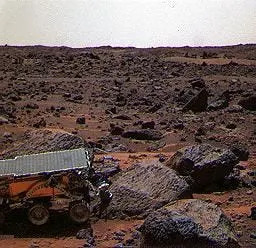
This image taken by the Imager for Mars Pathfinder (IMP) and released on October 8, 1997 by the Jet Propulsion Lab (JPL) shows the Sojourner rover's Alpha Proton X-ray Spectrometer (APXS) deployed against the rock "Moe". The rock behind rover is "Half Dome", which has also been analyzed.
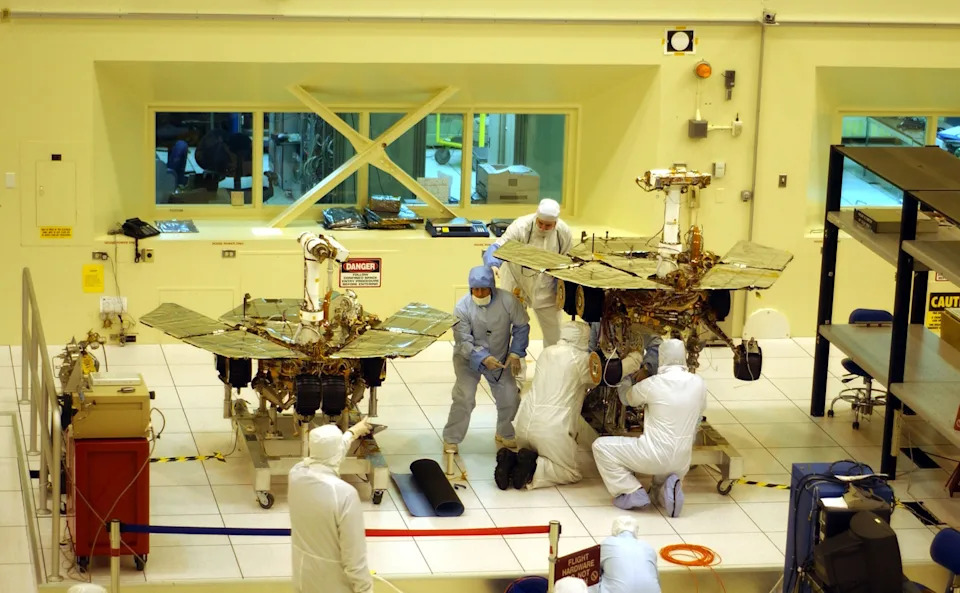
Workers put final touches to the two new Mars exploration rovers at NASA Jet Propulsion Laboratory (JPL) February 10, 2003 in Pasadena, California. The identical robotic explorers, Spirit and Opportunity, will trek up to 109 yards each Martian day, far more than the much smaller Mars Pathfinder was able to do in 1997. The rovers will search for evidence of liquid water in two separate areas of the red planet. The rovers stand about five feet tall and weigh in around 400 pounds. The first rover has a launch opportunity May 30, 2003 and the second June 25, 2003.
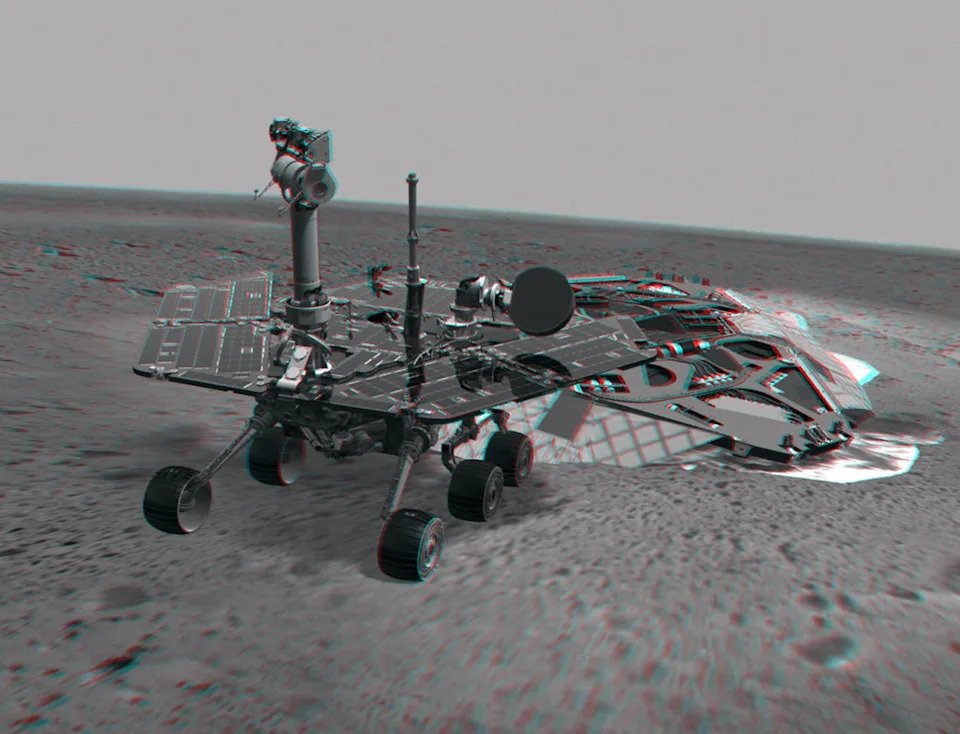
This 3-D image released by NASA January 23,, 2004 combines computer-generated models of the Mars Exploration Rover Spirit and its lander with real surface data from the rover's panoramic camera. NASA made progress in fixing its malfunctioning Mars rover Spirit by finding a work-around for a balky memory card. "We made good progress overnight. The rover has been upgraded from critical to serious." said Peter Theisinger, rover project manager, at an afternoon press briefing 24 January at the Jet Propulsion Laboratory (JPL). Theisinger said that ground controllers have established an ability to communicate with and control the vehicle reliably. Scientists said they managed to reset Spirit's computer and put the rover into what's called "cripple" mode to bypass software problems. Still, the problems may prevent the rover from taking another drive on Mars for as long as three weeks.
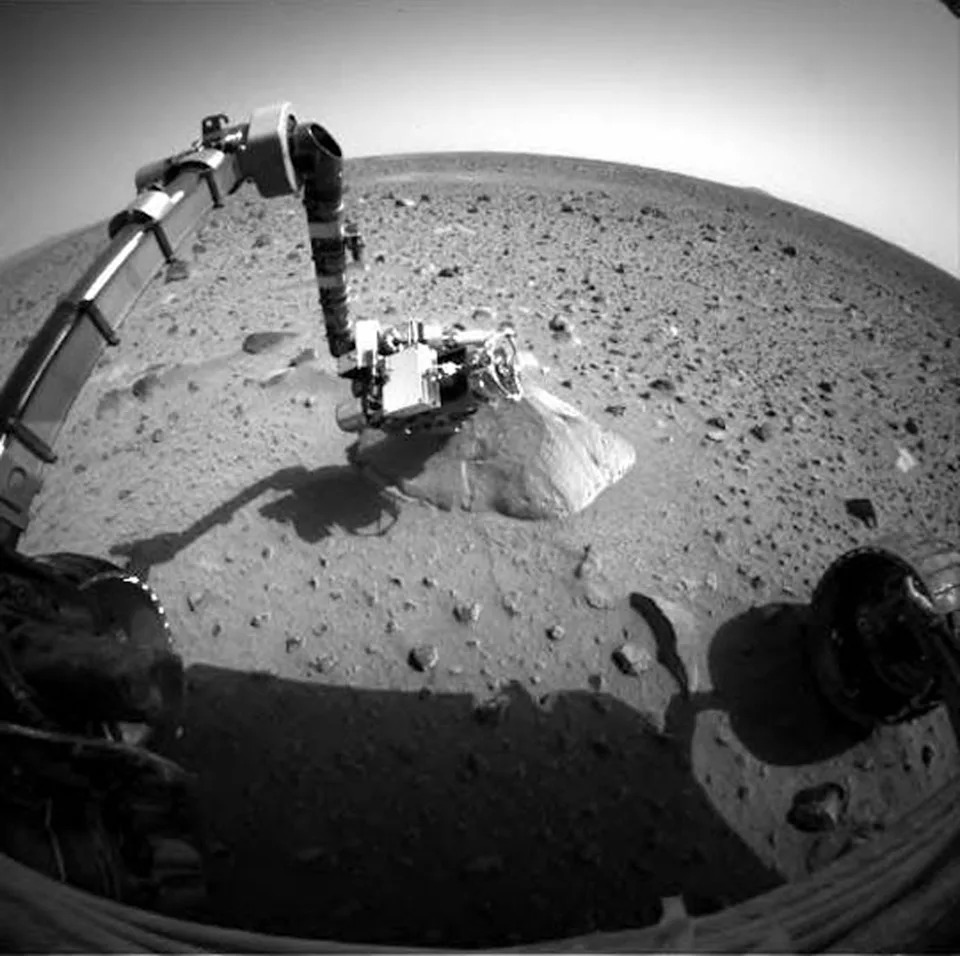
In this handout image provided by the National Aeronautics and Space Administration (NASA)/JPL, NASA's Mars Exploration Rover Spirit took and returned this image on January 28, 2004, the first picture from Spirit since problems with communications began a week earlier. The image from the rover's front hazard identification camera shows the robotic arm extended to the rock called Adirondack. As it had been instructed a week earlier, the Moessbauer spectrometer, an instrument for identifying the minerals in rocks and soils, is still placed against the rock. Engineers are working to restore Spirit to working order so that the rover can resume the scientific exploration of its landing area.
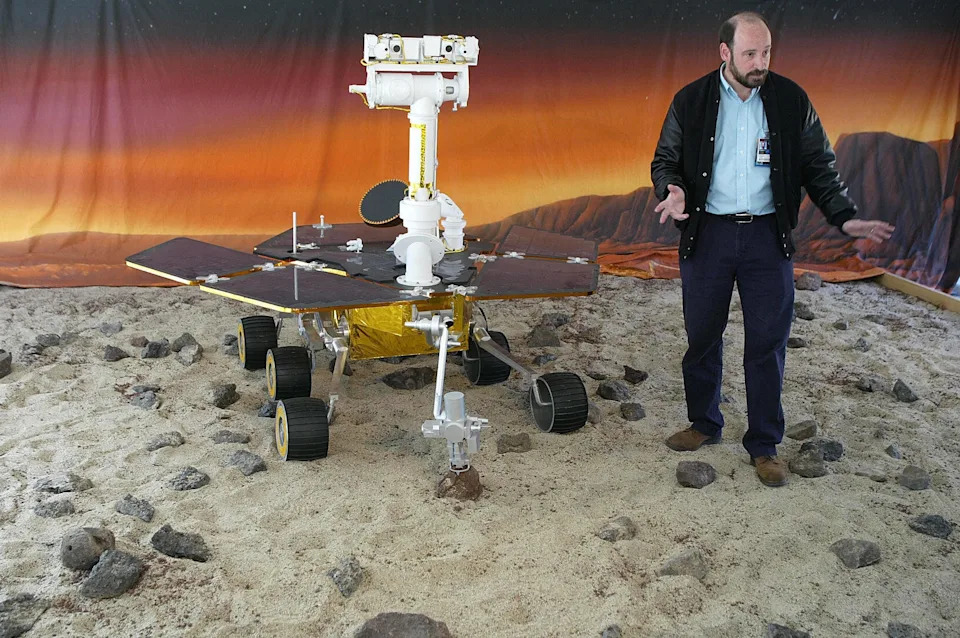
NASA's Jet Propulsion Laboratory (JPL) Navigator Program Engineer Dr Randii Wessen discusses the Mars Exploration Rover (MER) beside a model of the MER in a "sandbox" at the JPL in Pasadena, California on January 21, 2004. With the first rover named "Spirit" already safely on martian soil, engineers and scientists are gearing up for the scheduled landing of the second rover "Opportunity" on the opposite side of Mars later this week.
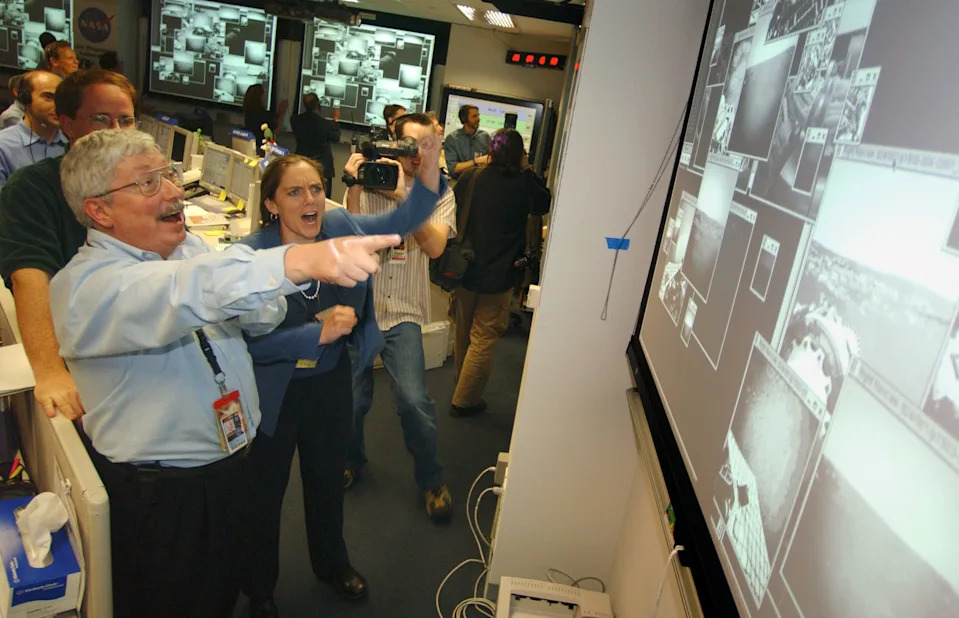
Pete Theisinger, project manager, lef, and Jennifer Trosper, Spirit Mission Manager for Surface Operations, react as the first images arrive from the NASA Mars Rover, "Opportunity," at Jet Propulsion Laboratory (JPL) on January 25, 2004 in Pasadena, California.
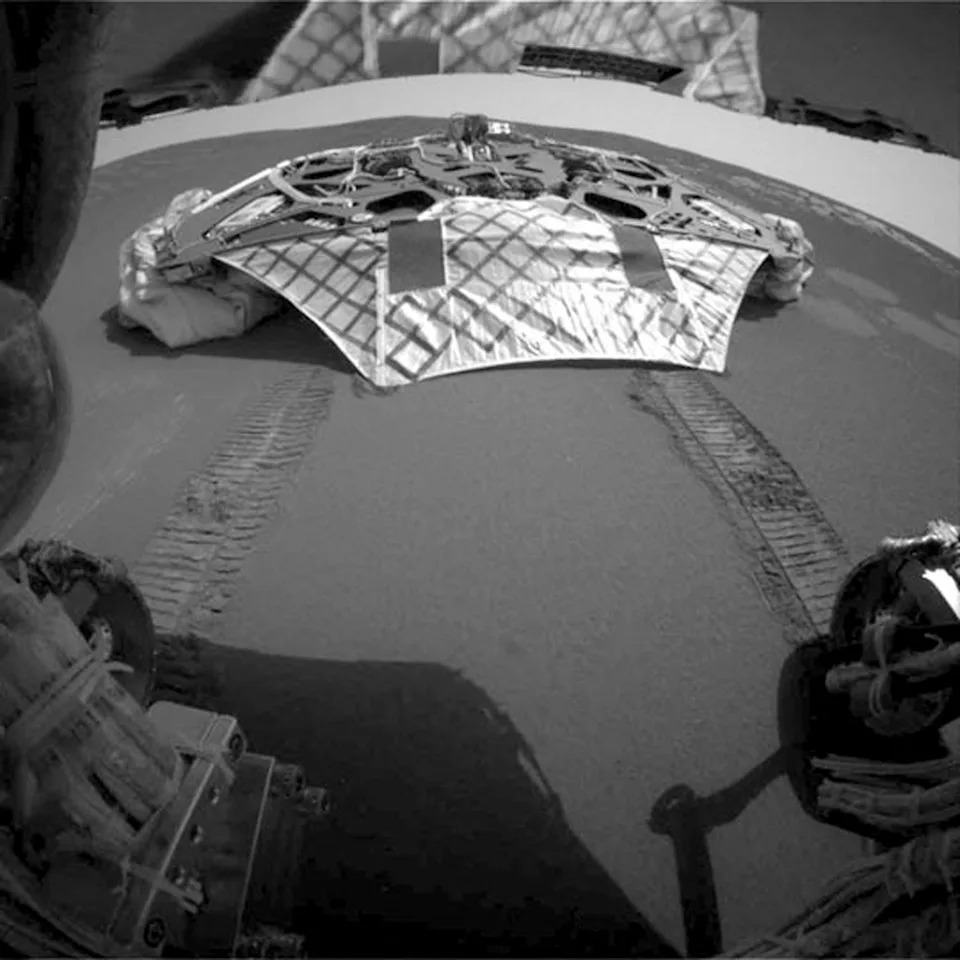
This black and white image released by NASA on January 31, 2004, shows rover lander Opportunity successfully drives off onto the surface of Mars. The US rover Opportunity drove across the surface of the planet Mars for the first time early Saturday nearly a week after landing on the planet, the US space agency NASA said.
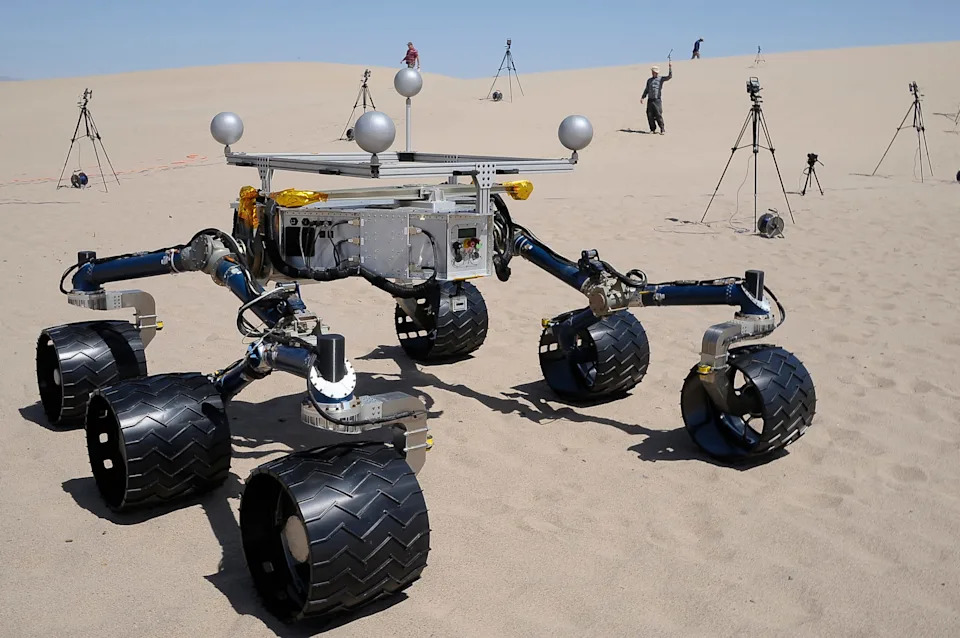
Members of the Mars Science Laboratory/Curiosity team, which includes rover drivers and scientists, test out an engineering model of its next generation Mars rover, dubbed "Curiosity", in the desert near Baker, California May 10, 2012. According to a press release from NASA, the rover is 89 days away from its August appointment with Mars.
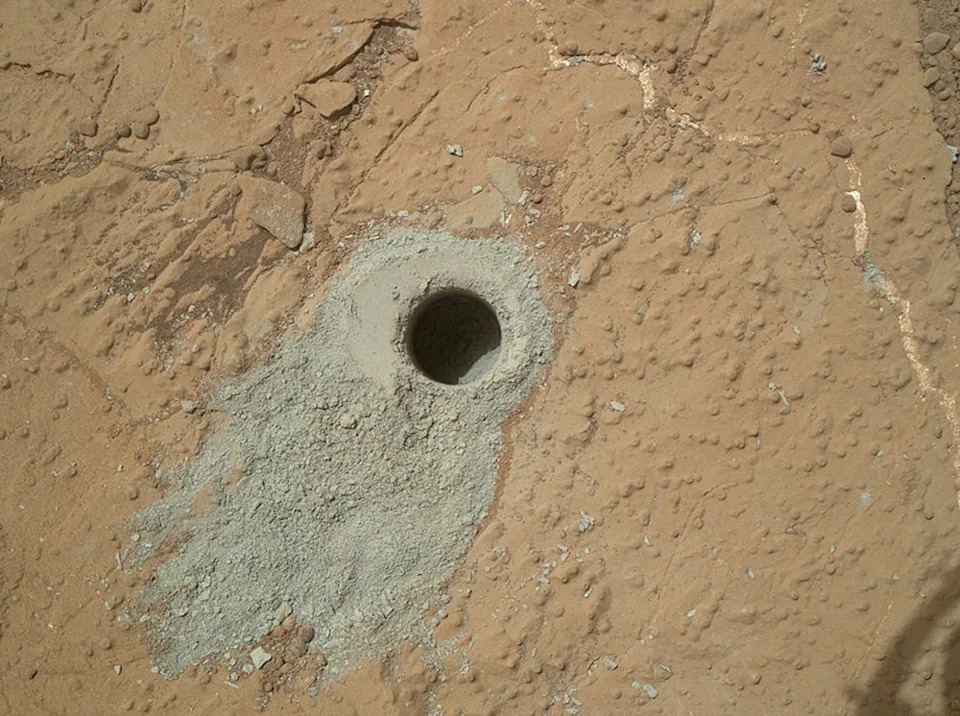
NASA's Mars rover Curiosity drilled into this rock target, "Cumberland," during the 279th Martian day, or sol, of the rover's work on Mars, on May 19, 2013 and collected a powdered sample of material from the rock's interior, in this handout photo provided by NASA . Methane in the Martian atmosphere and organic chemicals in the red planet's soil are the latest tantalizing findings of NASA's Mars Curiosity rover as it hunts for clues about the possibility of extraterrestrial life, scientists said on December 16, 2014.
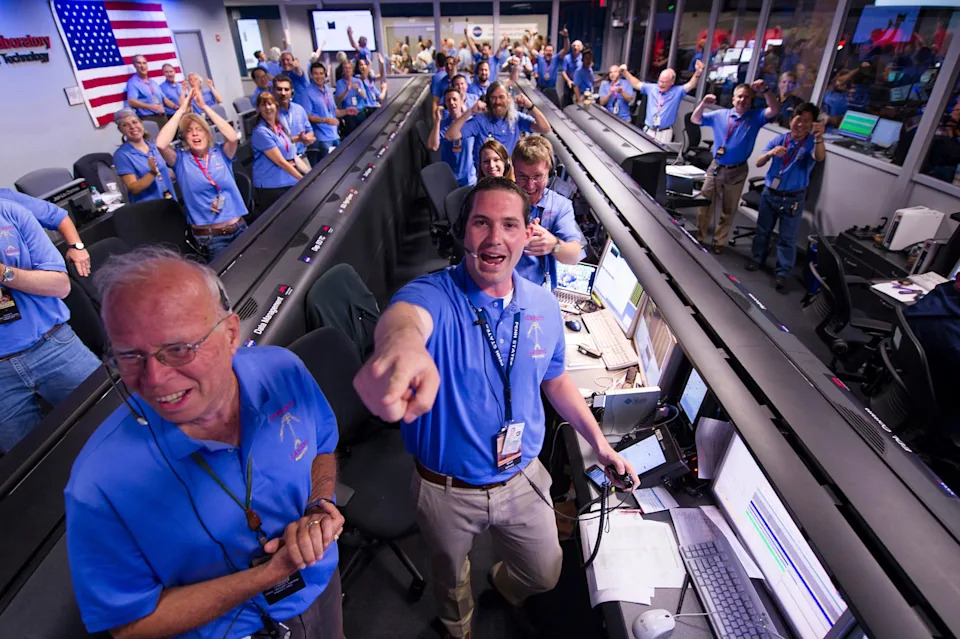
The Mars Science Laboratory (MSL) team in the MSL Mission Support Area reacts after learning the Curiosity rover has landed safely on Mars and images start coming into the Jet Propulsion Laboratory, in Pasadena, California in this August 5, 2012 handout photograph provided by NASA. Curiosity survived its daredevil landing on Mars one year ago Tuesday and went on to discover that the planet most like Earth in the solar system could indeed have supported microbial life, the primary goal of the mission.
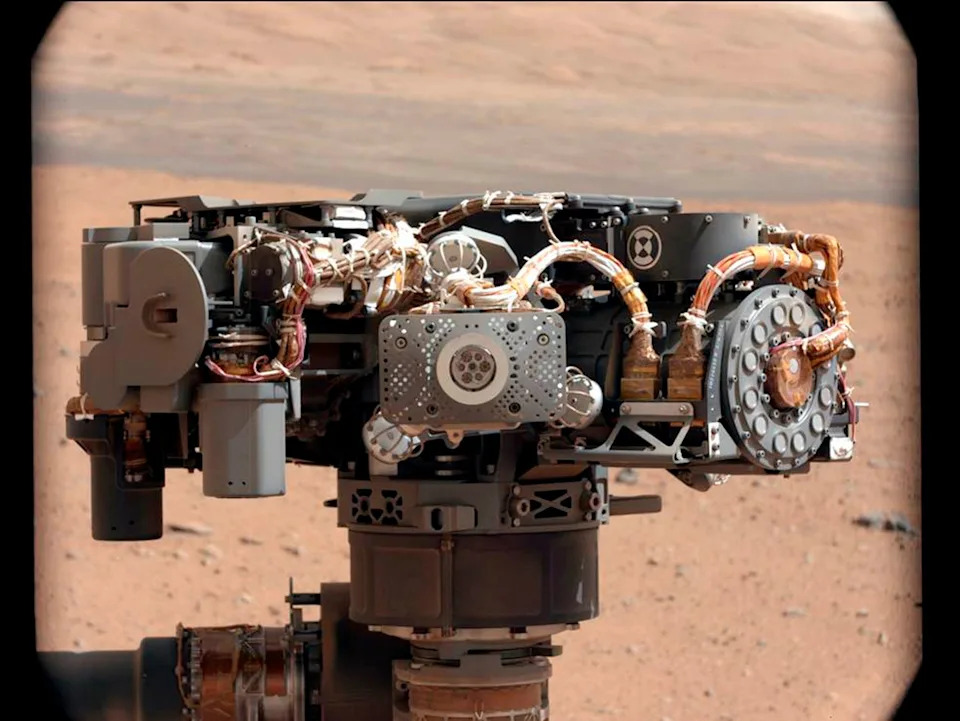
In this image taken by Curiosity's Mast Camera, the Alpha Particle X-Ray Spectrometer (APXS) on NASA's Curiosity rover is pictured, with the Martian landscape in the background on the 32nd Martian day, or sol, of operations on the surface on September 7, 2012, PDT or September 8, 2012, UTC. This image lets researchers know that the APXS instrument had not become caked with dust during Curiosity's dusty landing.
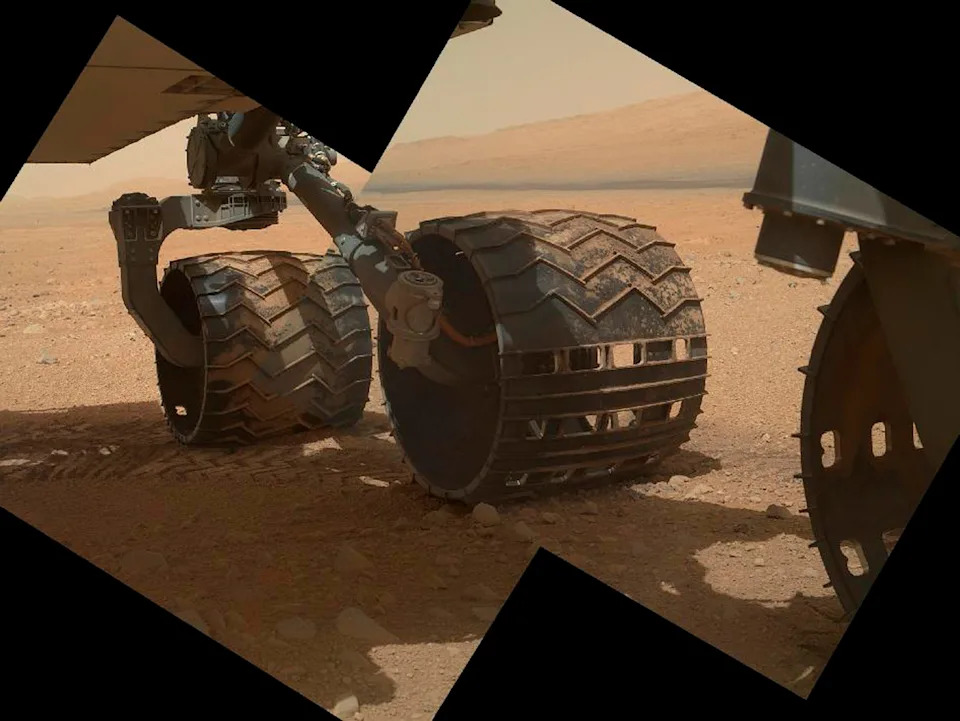
A NASA handout photo shows the three left wheels of NASA's Mars rover Curiosity combined in two images that were taken by the rover's Mars Hand Lens Imager (MAHLI) on September 9, 2012. In the distance is the lower slope of Mount Sharp.
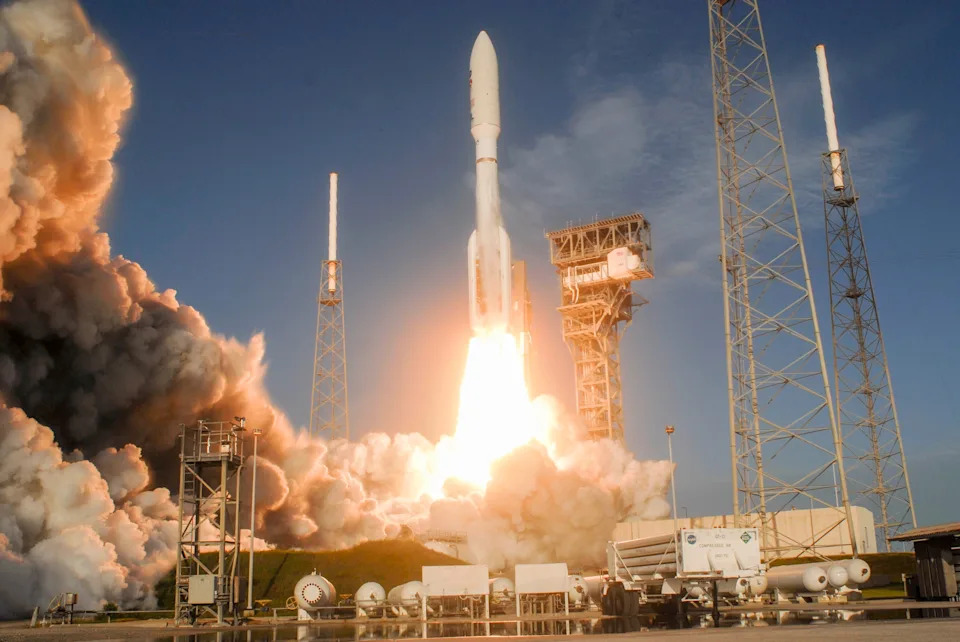
A United Launch Alliance Atlas V rocket lifts off from Cape Canaveral Space Force Station on Thursday, July 30, 2020, with NASA's Perseverance rover destined for Mars.
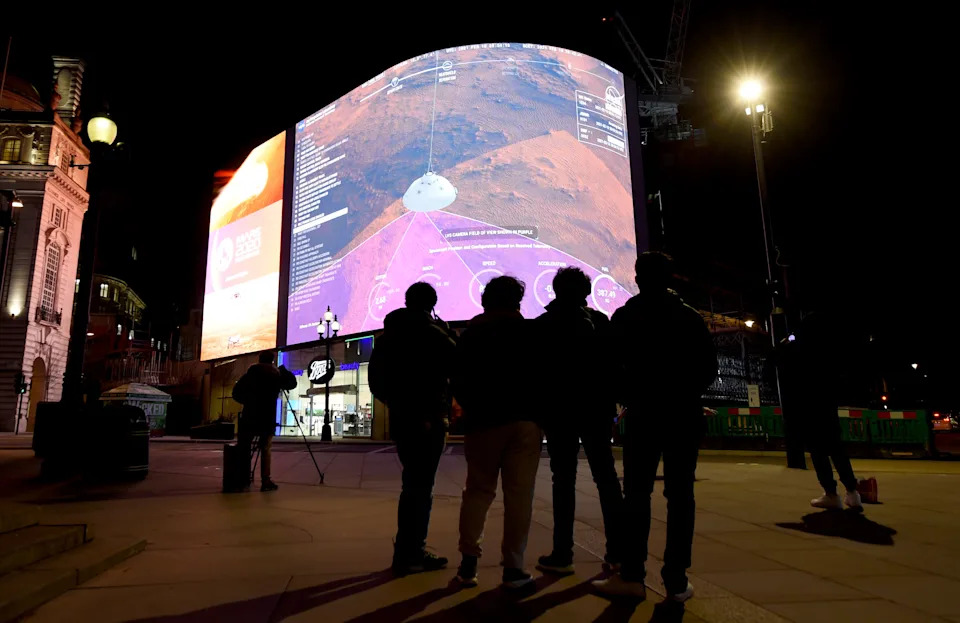
A general view of the live-stream landing of NASA's Perseverance on Mars at Piccadilly Circus on February 18, 2021 in London, England. The rover has been traveling through space since launching from Cape Canaveral at the end of July 2020.
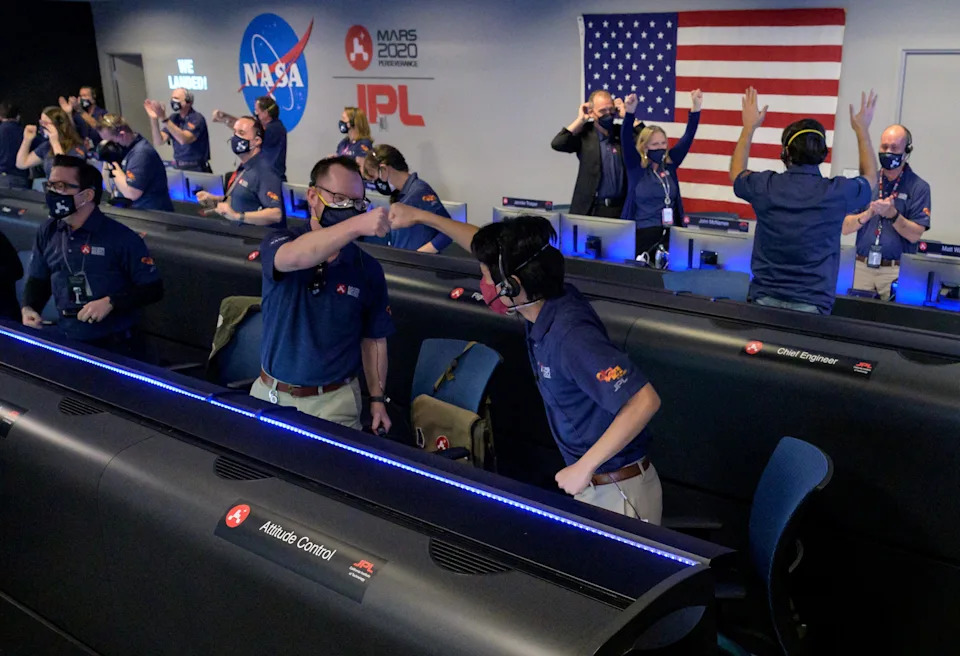
Members of NASAÕs Perseverance rover team react in mission control after receiving confirmation the spacecraft successfully touched down on Mars, at NASA's Jet Propulsion Laboratory in Pasadena, California, U.S. February 18, 2021. Picture taken February 18, 2021.
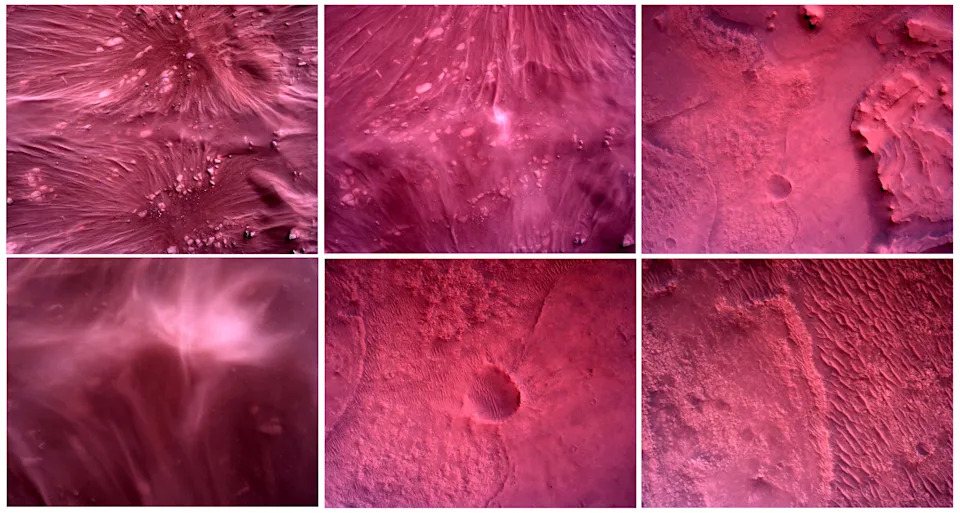
The surface of Mars directly below NASA's Mars Perseverance rover is seen using the Rover Down-Look Camera in a combination of images acquired February 22, 2021.
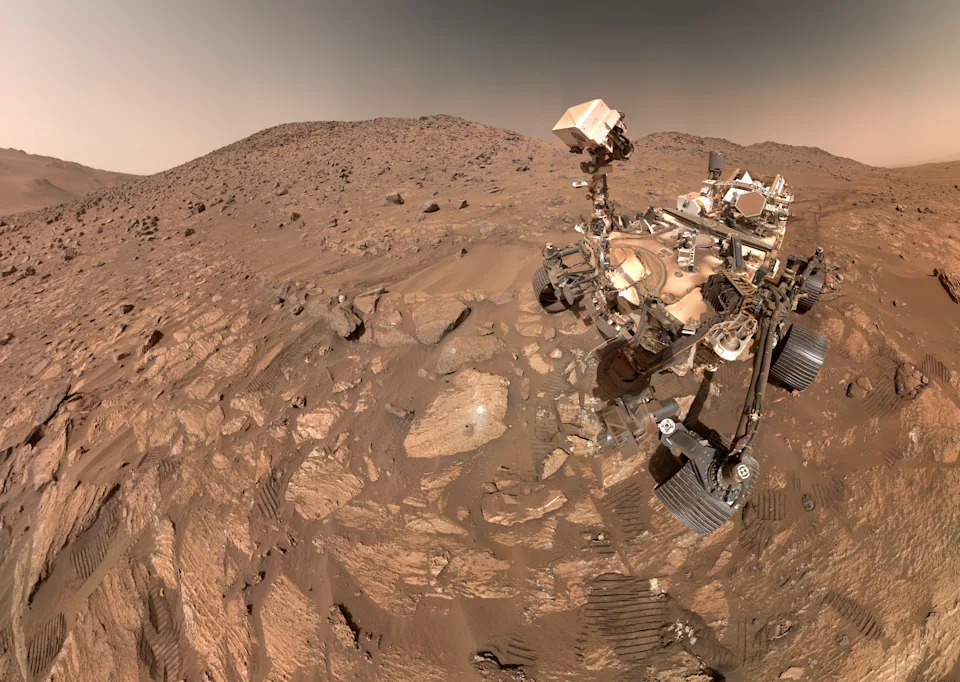
A "selfie" taken by NASA's Perseverance Mars rover, made up of 62 individual images, on July 23, in this image released on September 10, 2025. A rock nicknamed "Cheyava Falls," which has features that may bear on the question of whether the Red Planet was long ago home to microscopic life, is seen to the left of the rover near the center of the image.
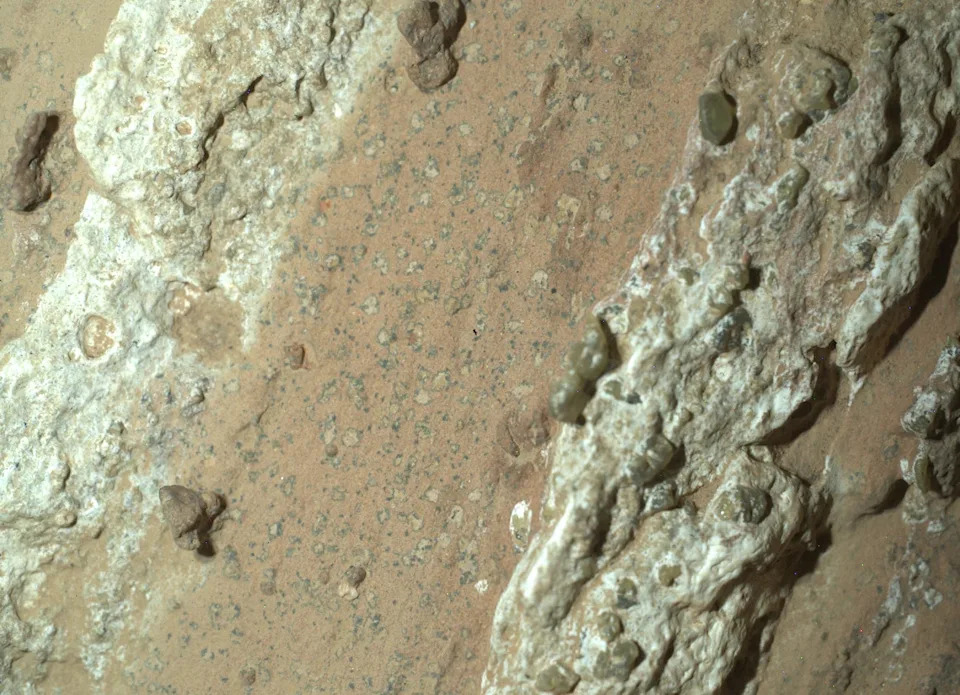
This handout photo obtained on September 10, 2025, from NASA/JPL-Caltech/MSSS shows an image taken by NASA's Perseverance rover that shows "leopard spots" on a reddish rock nicknamed "Cheyava Falls" in Mars' Jerezo Crater in July 2024 on Mars. Colorful, speckled rocks found on the surface of Mars have offered among the most encouraging evidence yet of ancient life on our neighboring planet, scientists at NASA announced on September 10, 2025. The Perseverance Mars rover collected the "Sapphire Canyon" rock samples in July 2024 from the bed of what's considered an ancient lake, and its poppyseed and leopard-esque spots pointed to potential chemical reactions that piqued the interest of researchers.
Pomozite nam da budemo bolji.